
On this page
The short answer
The ATI TEAS 7 has 170 questions in 209 minutes, split into four timed sections: reading, math, science, and English and language usage. Twenty of those questions are unscored pretest items, so 150 count toward your score, and you won't know which are which.
Most questions are classic multiple choice with four answer options, sometimes with a chart or graphic. ATI says approximately 20% are alternate item types, so roughly 34 of the 170 questions could ask you to do something other than pick one letter. Those are the items that surprise people on test day.
The five TEAS question types
ATI lists five formats for TEAS Version 7:
The clicking is simple. The challenge is that alternate items take away the safety net of eliminating three wrong letters, so you need to actually know the answer.
Check yourself
4 quick questions on this topic
Question 1 of 4
The metric system is based on units of:
Answer: B. The metric system uses powers of 10, making conversions simple.
Question 2 of 4
The metric system is based on units of:
Answer: B. The metric system uses powers of 10, making conversions simple.
Question 3 of 4
Which organ system transports oxygen, nutrients, and hormones throughout the body?
Answer: B. The circulatory (cardiovascular) system moves blood carrying oxygen, nutrients, and hormones.
Question 4 of 4
Which organ system transports oxygen, nutrients, and hormones throughout the body?
Answer: B. The circulatory (cardiovascular) system moves blood carrying oxygen, nutrients, and hormones.
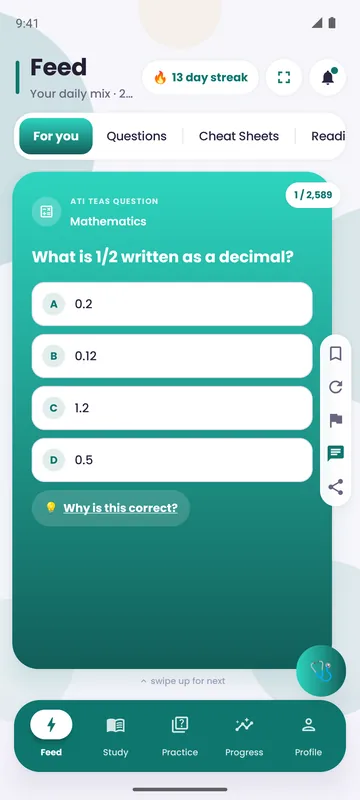
Keep the streak going with more questions like these, each with a full rationale.
How each type is scored: no partial credit
ATI is clear: every question is scored correct or incorrect, with no partial credit. That rule hits hardest on multiple-select and ordered-response items.
Say a science item lists six choices and three are correct. Pick two of the three and the item is wrong. Pick all three plus one extra and it's still wrong. On an ordered-response item, five steps in the right order with one swap scores zero. Fill-in-the-blank items reward precision too: the right method with a misplaced decimal earns nothing.
The fix for multiple select is to treat each option as its own true-or-false statement about the stem. That avoids the most common mistake, which is choosing options because they sound related to the topic.
Examples of each alternate type
These are original practice items written in the TEAS style, with answers:
Section numbers, timing and tools
Sections always run in the same order: reading, math, science, then English and language usage.
That works out to about 1.2 minutes per reading question, 1.5 per math question, 1.2 per science question and exactly 1 per English question. Alternate items usually take longer than a standard multiple-choice question, so bank time on the quick ones.
Strategy for the non-multiple-choice items
A few habits fix most alternate-item misses. Then practice in the formats, not just the content. The CinnaEntry bank has 5,260 questions, including 664 TEAS science and 529 TEAS math items, and the quiz on this page mixes conversions, body systems and grammar so you see the styles side by side.
Frequently asked questions
Is the TEAS test all multiple choice?
No. About 20% of TEAS 7 questions are alternate types: multiple select, fill in the blank, ordered response and hot spot. The rest are four-option multiple choice.
Is there partial credit on TEAS select-all-that-apply questions?
No. ATI scores every question as correct or incorrect, so your selections must match every correct option with no extras.
Can you use a calculator on the ATI TEAS?
Yes. A calculator is built into the exam and available in every section. Personal calculators are not allowed.
How many questions are on the ATI TEAS 7?
170 questions in 209 minutes. Twenty are unscored pretest items, so 150 count toward your score.
Can you go back to questions on the TEAS?
Within a section, yes: you can move back and forth and flag questions until you submit it. After you submit a section, you can't return.
Keep studying
Sources
Checked against official sources