
Anatomy and Physiology is about 25 questions on the HESI A2, which makes it one of the shorter sections. Do not let that fool you into revising it last. Many programmes set a separate minimum on it, and some weight it above the cumulative score, because performance here tracks closely with surviving the first year of a nursing programme.
What is actually asked
The level is introductory. You are not being asked to trace a metabolic pathway. You are being asked whether you know what a structure does, where it sits and which system it belongs to.
- Terminology and organisation. Directional terms, body planes, cavities, levels of organisation from cell to organism.
- Cardiovascular. Chambers, valves, the path of blood through the heart and lungs, what arteries and veins do.
- Respiratory. The route air takes, gas exchange at the alveoli, the muscles of breathing.
- Musculoskeletal. Bone types, major bones, joint types, how muscles produce movement in pairs.
- Nervous. Central against peripheral, the neuron, the lobes and what each does, reflex arcs.
- Digestive, renal, endocrine, integumentary, immune and reproductive. Fewer questions each, but they appear.
Learn paths, not lists
A list of heart structures is forgettable. The path of one drop of blood is not: vena cava, right atrium, tricuspid valve, right ventricle, pulmonary valve, pulmonary artery, lungs, pulmonary vein, left atrium, mitral valve, left ventricle, aortic valve, aorta. Say it once a day for a week and you have answered every chamber, valve and vessel question the exam can build.
The same trick works for air, for food and for urine. Four paths cover a surprising share of the section.

Where people lose marks
Confusing the two circuits. Pulmonary carries deoxygenated blood away from the heart; systemic carries oxygenated blood away. The rule that arteries always carry oxygenated blood is wrong, and the exam knows it is a common belief.
Left and right. Anatomical left is the patient's left, not yours. Diagrams are drawn facing you.
Similar names. Ureter against urethra, ilium against ileum, malleus against malleolus. Learn them in pairs, deliberately, because meeting them separately is how they blur.
How to revise 25 questions worth of material
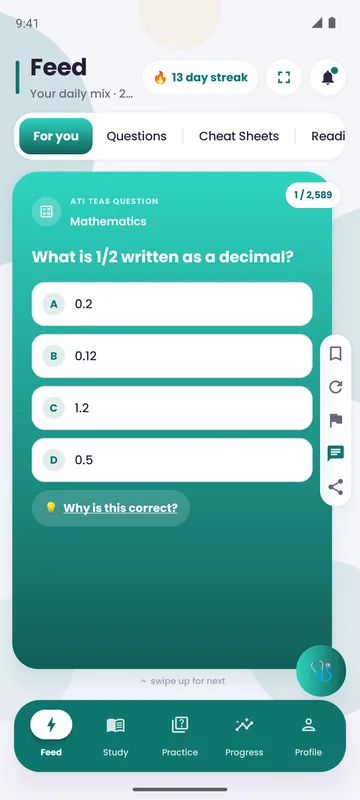
Do not read a textbook chapter. Work system by system: answer ten questions on a system, read the rationale on every option, then read one cheat sheet on that system, then move on. Ten systems at roughly forty minutes each is a week of evenings, and it covers the section properly.
Next, the section with twice the questions and half the fear: HESI A2 mathematics.