
Vocabulary and General Knowledge is about 50 questions, and it frightens people because it feels unbounded. It is not. The section draws on a stable pool of words that matter in a clinical setting plus everyday academic words, and the same families come back year after year.
How the questions are framed
Most take one of three shapes:
- Definition. "What is the meaning of the word occluded?"
- In a sentence. A clinical sentence with one word tested, where the context usually rules out two of the four options.
- Best fit. A sentence with a gap and four plausible words, only one of which is used correctly.
The groups worth learning first
Words that describe change. Distended, contracted, occluded, dilated, constricted, exacerbated, alleviated, abated. These carry most of the clinical weight and they recur.
Words that describe position and direction. Lateral, proximal, distal, superficial, deep, anterior, posterior. These overlap with Anatomy and Physiology, so the study time counts twice.
Words that describe severity and frequency. Acute, chronic, intermittent, persistent, transient, insidious, latent.
Words that describe how something is given or taken. Oral, topical, parenteral, prophylactic, therapeutic, contraindicated.
Everyday academic words. Discrete against discreet, adverse against averse, precede against proceed, affect against effect. These are not medical and they appear anyway.
Why word lists fail
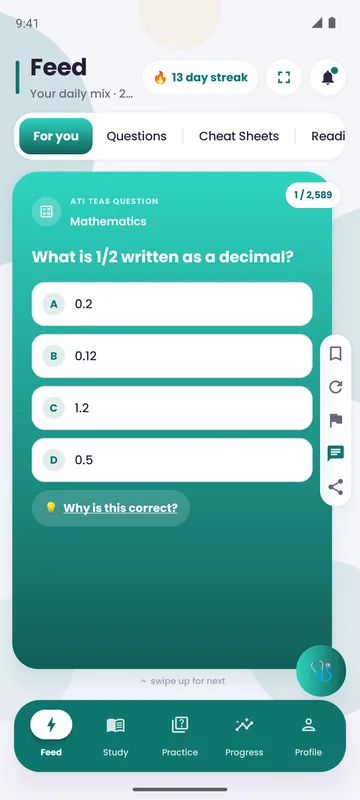
Reading a list of 300 words the night before produces recognition, not recall. You will look at four options, feel that two are familiar, and guess. What works instead is spaced retrieval: see a word, try to produce the meaning from memory, check, then see it again days later. Twenty words a day tested this way beats 300 words read once, and the effect is not close.
Use the exam against itself
When you meet an unknown word in a practice question, do not just learn that word. Note which of the four groups above it belongs to, and learn its opposite at the same time. Distended teaches you contracted for free, and the exam likes pairs.
Next, the section that carries the most weight for admission decisions: how to study the HESI A2 sciences.