
On this page
The short answer: one blueprint, many forms
ATI uses the word 'version' in two ways, which is where the confusion starts. A blueprint is the test design: sections, topics, question counts and timing. ATI says there have been seven TEAS blueprints since the exam began. The current one is Version 7, which is why people call it the TEAS 7.
For each blueprint, ATI writes multiple versions of the exam. ATI says not every student will get the exact same one, and the odds of seeing the same exam twice are low. All versions are equated, meaning they're comparable and aligned to the current blueprint. You aren't lucky or unlucky in which form you get.
What every current TEAS has in common
Whichever form you draw, the structure is fixed. You get 170 questions: 150 scored and 20 unscored pretest questions mixed in, with no way to tell them apart. The sections always come in the same order.
- Reading: 45 questions in 55 minutes (39 scored).
- Math: 38 questions in 57 minutes (34 scored).
- Science: 50 questions in 60 minutes (44 scored).
- English and Language Usage: 37 questions in 37 minutes (33 scored).
- Total: 209 minutes, plus an optional 10-minute break after math that doesn't use testing time.
- A built-in calculator is available in every section. Personal calculators aren't allowed.
Check yourself
4 quick questions on this topic
Question 1 of 4
A 'prerequisite' is something that:
Answer: A. Anatomy and physiology is a prerequisite for nursing school — it must be completed before entry.
Question 2 of 4
Which best describes the purpose of a scientific model?
Answer: B. A model represents an object, system, or idea to help understand and explain it.
Question 3 of 4
Which best describes the purpose of a scientific model?
Answer: B. A model represents an object, system, or idea to help understand and explain it.
Question 4 of 4
The frontal lobe of the brain is mainly responsible for:
Answer: B. The frontal lobe handles higher functions like reasoning, planning, and voluntary movement.
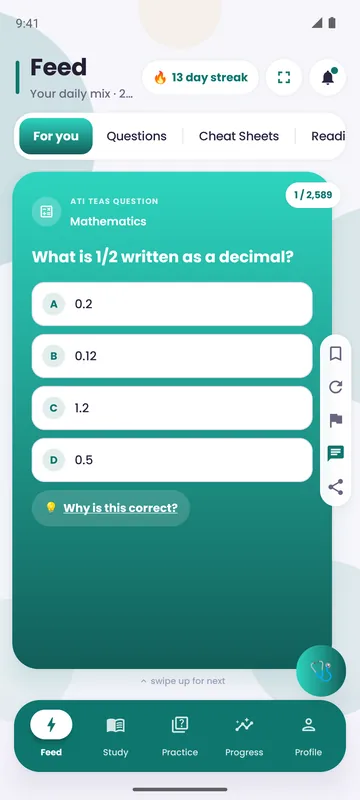
Keep the streak going with more questions like these, each with a full rationale.
What can differ between test takers
Two things differ. The first is the form, explained above. The second is delivery. ATI's registration page lists three routes: online with ATI or school proctoring from home (webcam, quiet private room), in person at your school or a PSI testing center, and PSI remote testing. Price depends on format and proctor and is shown at checkout. That's why classmates sometimes quote different fees for the 'same' test.
The exam itself doesn't change with the delivery method. Same sections, same timing, same scoring.
How Version 7 differs from older TEAS editions
Version 7 kept the four sections, each timed separately. It added alternate item types beyond standard multiple choice, which ATI says are designed to resemble next-generation NCLEX formats: multiple select, fill-in-the-blank, drag-and-drop and hot spot. ATI says multiple-select questions are all-or-nothing, so there's no partial credit for getting some of the boxes right.
If you're using an old prep book written for an earlier blueprint, the core concepts still help, but the question mix and item types won't match. Check any practice material against the current section counts above.
Which TEAS do I take?
Whichever one your school accepts, and in 2026 that means the current ATI TEAS. Since the version is the same for everyone, the questions to ask your program are about policy, not edition:
- Which delivery options do you accept: at home, on campus or a PSI center?
- What score do you require, and what score is competitive for admission?
- How many attempts do you allow, and how long between them? ATI doesn't cap attempts; schools set the limits.
- How old can my score be? ATI says schools decide, and two years is common.
- Do you receive scores automatically, or do I send an ATI transcript?
Will a retake give me the same questions?
Probably not, and that's by design. Because forms are equated, a retake isn't easier or harder. It's a fresh sample of the same blueprint. Memorizing questions from your last attempt won't help. Fixing the content behind your weakest section will.
Before you retake for a higher score, check two things. Do you have attempts to spare under your school's policy? And which section pulled your score down? Your score report breaks results down by section. If one area is far below the others, aim your next two to four weeks there instead of redoing everything.
Pacing and prep for the current version
Do the math on time per question. English gives you about 1 minute per item, science and reading about 1.2 minutes, and math about 1.5 minutes. English is the section where slow readers run out of time, so practice it timed.
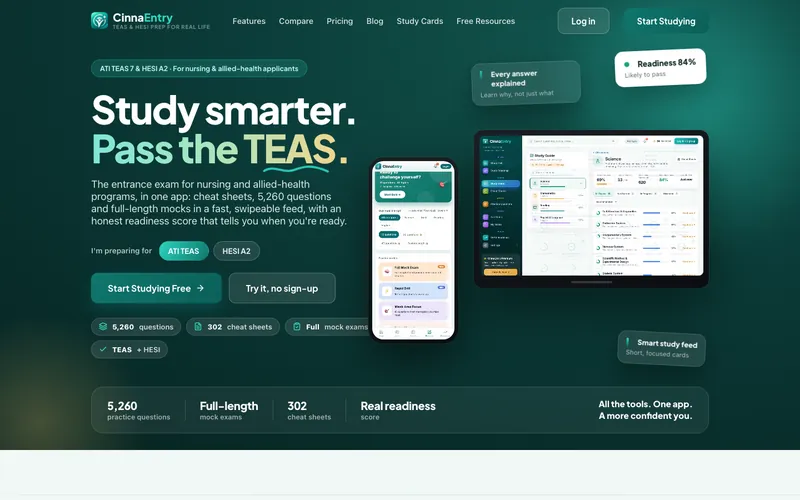
The CinnaEntry bank has 5,260 questions, including 664 TEAS science, 645 TEAS reading, 562 TEAS English and 529 TEAS math. Take the practice quiz on this page, then do one full timed section in the area you scored lowest.
Frequently asked questions
What TEAS test is it in 2026?
The ATI TEAS, Version 7 blueprint. It has 170 questions (150 scored) in four timed sections totaling 209 minutes.
Are all TEAS tests the same?
The structure, timing and scoring are the same for everyone. The questions vary because ATI builds multiple equated versions of each blueprint, so you may get a different form from someone else, or from your own earlier attempt.
Is the TEAS test timed?
Yes. Each section has its own clock: reading 55 minutes, math 57, science 60 and English 37. When time runs out, the section closes and unanswered questions are scored as incorrect.
How many questions are on the TEAS 7?
170 questions: 45 reading, 38 math, 50 science and 37 English and language usage. Twenty of them are unscored pretest items.
How long are ATI TEAS scores good for?
Your school decides. ATI says two years is common, but policies vary, so check with each program you apply to.
Keep studying
Sources
Checked against official sources