Ligament joins BONE to BONE. Tendon joins MUSCLE to BONE.
Before you read
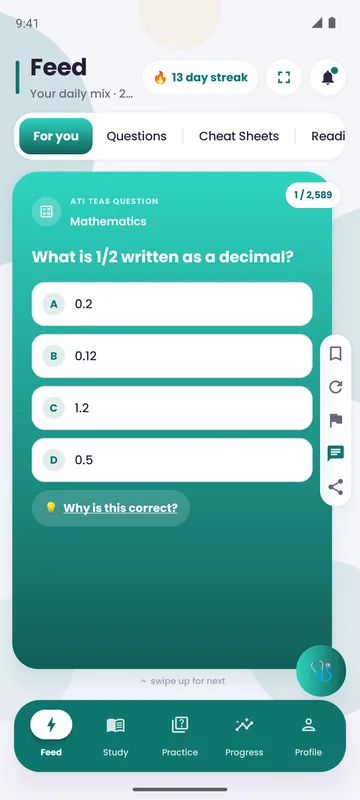
Test yourself first: 5 questions
Question 1 of 5
The liquid connective tissue that transports cells and nutrients through the body is:
Answer: B. Blood is classified as a connective tissue; it transports cells, nutrients, gases, and wastes.
Question 2 of 5
Which of these is the correct order of organization, simplest to most complex?
Answer: A. Cell → tissue → organ → organ system → organism. Similar cells form a tissue; several tissues form an organ.
Question 3 of 5
Which vessels have walls thin enough to allow the exchange of gases and nutrients with tissues?
Answer: C. Capillaries have one-cell-thick walls, allowing oxygen, nutrients, and wastes to diffuse between blood and tissue.
Question 4 of 5
A group of similar cells working together to perform a function is a:
Answer: B. Cells → tissues → organs → organ systems. A tissue is a group of similar cells with a shared function.
Question 5 of 5
The tiny blood vessels where oxygen and nutrients pass into body tissues are:
Answer: B. Capillaries are thin enough to let oxygen and nutrients diffuse into tissues.
Keep the streak going with more questions like these, each with a full rationale.
Key points
- Ligament joins BONE to BONE. Tendon joins MUSCLE to BONE.
- Hinge joints move in one plane — knee and elbow (flexion and extension).
- Ball-and-socket joints move in many planes — hip and shoulder.
- Pivot joints allow rotation — the neck (atlas/axis) and the forearm.
- Cartilage cushions the joint surfaces and reduces friction; it has a poor blood supply, so it heals slowly.
Study first
- A joint that only bends and straightens must be a hinge — so the knee is a hinge, not a ball-and-socket, even though it is large.
- Ask what tears in an ankle sprain: a LIGAMENT, because the injury is bone-to-bone stability, not a muscle attachment.
Commonly tested
- Move the joint on your own body and count the directions. One direction = hinge; many = ball-and-socket; rotation = pivot.
- For ligament/tendon, both words in the pair start with the letter of what they attach: Ligament–Limb bone, Tendon–musclE... use whichever mnemonic sticks, but pick one and keep it.
Watch out for
- Swapping ligament and tendon — remember 'ligament links limb bones'.
- Calling the knee a ball-and-socket because it is a major weight-bearing joint; size does not determine type, movement does.
- Forgetting that cartilage heals slowly, which is why joint injuries linger.
Joints & Connective Tissue: FAQs
What should I focus on first when studying Joints & Connective Tissue?
A joint that only bends and straightens must be a hinge — so the knee is a hinge, not a ball-and-socket, even though it is large. Ask what tears in an ankle sprain: a LIGAMENT, because the injury is bone-to-bone stability, not a muscle attachment.
What is most often missed on Joints & Connective Tissue?
Swapping ligament and tendon — remember 'ligament links limb bones'. Calling the knee a ball-and-socket because it is a major weight-bearing joint; size does not determine type, movement does. Forgetting that cartilage heals slowly, which is why joint injuries linger.
What do I need to know about Joints & Connective Tissue for the HESI A2?
Ligament joins BONE to BONE. Tendon joins MUSCLE to BONE. Hinge joints move in one plane — knee and elbow (flexion and extension). Ball-and-socket joints move in many planes — hip and shoulder. Pivot joints allow rotation — the neck (atlas/axis) and the forearm.
What are the most commonly tested points on Joints & Connective Tissue?
Move the joint on your own body and count the directions. One direction = hinge; many = ball-and-socket; rotation = pivot. For ligament/tendon, both words in the pair start with the letter of what they attach: Ligament–Limb bone, Tendon–musclE... use whichever mnemonic sticks, but pick one and keep it.