The major ions
Before you read
Test yourself first: 5 questions
Question 1 of 5
Most nutrient absorption occurs in the:
Answer: A. The small intestine's villi and microvilli give it an enormous surface area for absorption. The stomach mainly digests; the large intestine reabsorbs water and electrolytes.
Question 2 of 5
The chief function of the large intestine is to:
Answer: A. The large intestine reabsorbs water and electrolytes, converting liquid chyme into formed stool. Enzyme production is largely pancreatic; fat emulsification is done by bile.
Question 3 of 5
Homeostasis is best defined as the body's ability to:
Answer: A. Homeostasis is the maintenance of stable internal conditions — temperature, pH, glucose, fluid balance — despite changes outside the body. It is usually achieved by negative feedback.
Question 4 of 5
Which part of the brain controls balance and coordination?
Answer: A. The cerebellum coordinates movement, posture and balance. The cerebrum handles higher thought, the medulla controls vital autonomic functions, and the hypothalamus regulates homeostasis.
Question 5 of 5
Which part of the brain controls balance and coordination?
Answer: B. The cerebellum coordinates movement and balance. The cerebrum handles thinking; the medulla controls vital reflexes.
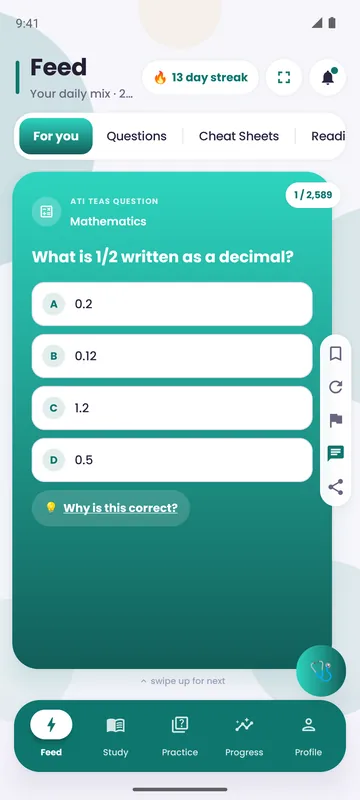
Keep the streak going with more questions like these, each with a full rationale.